This is a twist on two truths and a lie where teams compete to spot which answer in each round was generated by AI rather than written by a colleague. It scales the classic format to the whole team by mixing AI-generated answers with human ones.
Rules. Run 3 to 5 rounds. Before the game, the facilitator picks prompts (for example, “describe our biggest project as a movie trailer”). For each prompt, they generate one AI answer using any browser-based AI assistant and mix it with 2 to 3 human answers collected in advance. Teams score a point for correctly identifying the AI-generated response. The highest score after the final round wins.
Who it suits. The suggested group size is 6 to 20 adults split into 2 to 4 teams. The time limit is about 12 to 15 minutes, including a quick explanation. It works remotely, in person, and hybrid with a shared screen or chat.
How to run it. You need any AI assistant in a browser, a shared doc or chat channel, and a basic timer. Prepare 6 prompts in advance so you can run 3 to 5 rounds and still have a spare. Read the answers aloud while teams discuss quietly before locking in votes via chat or poll. Pick prompts that invite a bit of personality rather than generic corporate topics.
Hybrid tips. In-room teammates should huddle around one laptop while remote teammates join via video. All guesses must be posted in a shared channel to keep it fair. Avoid side chatter in the room that remote people cannot hear.
Limitation. Groups at the small end of the range, around 6 to 8 people, can feel exposed when their answers are read, since it is easy to guess who wrote each one. The game can also skew toward more talkative writers unless you allow brief anonymous submissions instead of reading them live.

Each team member grabs a random item off their desk and, working with a partner, turns it into a fake product. The group votes on the best or funniest pitch.
Rules. Players pitch in pairs. Each pair gets 60 seconds to prepare and 45 seconds to pitch, and every member must speak. The pair names the product, states who it’s for, and gives one benefit. Everyone else votes in chat or by raised hands, and the winning pair takes the round.
Who it suits. For 5 to 15 participants, form pairs and one trio if needed, with everyone contributing to the pitch. Plan two rounds for 5 to 8 people or one round for 9 to 15, within a 10- to 15-minute slot. Playable in person, remote, or hybrid without any special tools beyond a video call or a shared room.
How to run it. Announce the structure clearly and give one example pitch so the format clicks. Enforce the time limit strictly. Mixing themes across rounds (productivity gadget, wellness tool, novelty toy) keeps it fresh and forces creative thinking. The game uses only the materials people already have on their desks, so there is zero cost and zero prep.
Hybrid tips. Remote and in-room participants all join the same call. In-room players hold up items to the camera, and voting happens in a single shared poll or chat so no one team member is drowned out by in-room reactions.
Limitation. Pitching still puts people on camera, so let any pair decide who opens and who closes. Let a pair pass on one round without losing their earlier points.

A structured problem-solving relay where small teams race to solve a sequence of short riddles or logic questions. This format builds light competitive energy without requiring anyone to perform in front of the entire team. Folding in a few company-specific questions works well here.
Rules. Teams receive Riddle 1. When they submit a correct answer to the facilitator, they get Riddle 2, and so on. The first team to solve all riddles, or the most riddles within 10 minutes, wins. Tiebreaker goes to the fastest submission time.
Who it suits. Works well with 6 to 24 adults in groups of 3 to 5, with total runtime around 12 to 15 minutes, including a 75-second explanation. Especially good for established teams who enjoy problem-solving challenges.
How to run it. Prepare 6 to 10 short riddles or lateral-thinking puzzles in advance, using a shared doc or slides. Appoint someone to track answers and time. Announce when 2 minutes remain to trigger final guesses. The best team-building games create shared goals and communication challenges, so write at least one riddle that requires information from more than one team member to solve.
Hybrid tips. Have all answers submitted through chat or a shared form so remote and in-person subteams are treated the same. If using breakout rooms, keep each team mixed with remote and in-room participants to avoid sideline spectators.
Limitation. People who dislike puzzles may disengage. Replace one or two riddles with team trivia questions about your organization, project, or shared day-to-day work, which broadens the appeal for people who don’t enjoy lateral-thinking puzzles.

A silent storytelling race where small groups create a short story using only emoji, and other teams compete to decode the story accurately. It rewards creative problem solving and gives quieter group members a structured turn without requiring anyone to speak on the spot.
Rules. In round one, teams have 3 minutes to create a sequence of 6 to 10 emojis that represents a simple narrative (for example, “product launch disaster to recovery”). The storytelling team writes down its three scorable plot elements before any guesses are read out. In round two, the sequences are shared anonymously, and other teams have 2 minutes to write what they think the story is. Teams earn 1 point for each correct plot element guessed, plus bonus points for the most “liked” story.
Who it suits. Best for 6 to 20 participants split into 2 to 4 teams. One full cycle of create, guess, and scoring takes 10 to 15 minutes. It works on chat, whiteboards, or physical sticky notes for in-person play.
How to run it. Use chat emoji, an online whiteboard, or printed icon sheets. The scoring rules need to be crystal clear before round one starts: 1 point per correct plot element, bonus for audience favorite.
Hybrid tips. Share all emoji stories in one digital space (screen share or channel), and have in-room players add emojis via laptop instead of paper so remote colleagues see everything at the same time.
Limitation. Some participants may struggle if they are less familiar with emoji meaning or have visual impairments. Post every emoji sequence with a short plain-text description alongside it, which works for screen readers and for anyone who reads emoji differently. Avoid ASCII symbols as the alternative, since they create the same accessibility problem.

The classic Human Knot game encourages clear communication and collective problem-solving. This version adds a hard time limit and a parallel remote alternative, so the whole team plays at once, regardless of where they sit.
Rules. Players stand in a tight circle, close their eyes, and each person grabs two different hands across the circle. On “go,” they open their eyes and have up to 8 minutes to untangle into a single ring or two smaller circles without releasing hands. They win if they fully untangle before time expires. This game requires no materials.
Who it suits. Fits 6 to 12 in-person participants, requires clear safety space, and works best for groups comfortable with light physical contact. For remote colleagues, run a simultaneous “knot drawing” puzzle where they must reorder tangled lines on a shared whiteboard to match a reference image.
How to run it. Clear the chairs, set ground rules about moving slowly and respecting boundaries, and keep one timed round so the game stays inside its slot. Designate one team member as timekeeper.
Hybrid tips. Do not run the physical Human Knot while others watch on video. Split into two games at the same time: in-room players do the physical knot while remote teammates solve a shared "knot" puzzle, then compare strategies.
Limitation. This game will not suit teams with mobility limitations, people uncomfortable with touch, or formal dress. Skip or replace it rather than forcing participation.

Escape rooms are popular team-building activities that foster collaboration, but a full-length escape room takes 60 minutes or more. This compact version borrows the puzzle mechanics and compresses them into a single shared grid solvable in about 15 minutes.
Rules. Teams receive a one-page grid of 9 cells, each holding a small puzzle, code, or image. Solving any 5 cells reveals the final meta clue (a word, number, or phrase). The first team to submit the correct meta answer within the time limit wins.
Who it suits. Works for 4 to 16 players in teams of 2 to 4, with 90 seconds for the rule explanation and 12 minutes for solving. The grid needs to be self-explanatory on the page rather than talked through. It runs fully remote, in person with printed sheets, or hybrid via a shared whiteboard. You can also give each sub-team only part of the grid, so they must trade information.
How to run it. Prepare the grid in advance using a simple presentation or online whiteboard. Mix easy and medium puzzles to avoid stalls. Give clear instructions on how many cells must be solved to unlock the final clue and how to submit answers. Write puzzles that require team collaboration rather than individual recall.
Hybrid tips. Each team shares one digital copy of the grid so remote and in-room teammates can annotate together. Do not read clues out loud in the room without sharing on screen, or remote participants get left behind.
Limitation. Designing a good grid takes prep time, often 30 to 60 minutes. Not everyone enjoys puzzle-heavy play, so this is better for teams that already like escape-room-style problem-solving.

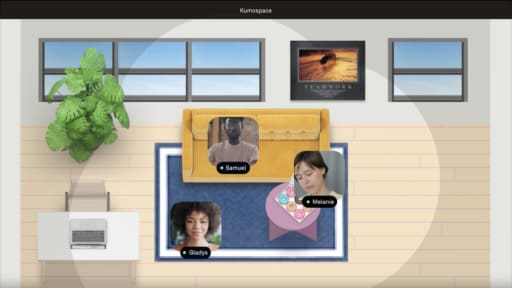
A spatial team-building game that uses movement between virtual or physical “rooms” and proximity audio. Teams complete short missions by overhearing and sharing clues scattered around the space. This format translates the scavenger hunt mechanic into something that works indoors or in a virtual office.
Rules. The facilitator places 6 to 10 short clues or instructions across different rooms or zones. Teams must collect enough clues to solve a final mission question (for example, "What three values define this project?" or "What is the correct sequence of steps?"). The first team to report the correct final answer wins.
Who it suits. Plan for 8 to 30 participants, split into 3 to 6 small teams. Keep rounds to 10 to 15 minutes. You need either an office with nearby rooms or a virtual office tool with rooms and spatial audio.
How to run it. In a virtual office such as Kumospace, which has spatial audio, avatar movement, and rooms, you place clues in different rooms, and people move their avatars to "overhear" them. In person, station a volunteer in each area to read that area's clue aloud only when someone enters. The overheard mechanic adds a layer of attentiveness that a simple item-collection hunt lacks.
Hybrid tips. Remote players navigate virtual rooms while in-person teammates move physically, but each team meets in the same audio space. Once a teammate finds a clue, they post it in the team’s shared chat, so nobody misses content because of where they are.
Limitation. This can feel chaotic without a map or clear boundaries. Limit it to one floor or a few virtual rooms, and provide a simple list of allowed zones.

A race where small teams interpret short status prompts using only emojis and score points for matching a hidden “answer key.” It works for remote and hybrid teams of almost any size because everyone responds at the same time.
Rules. The facilitator prepares 8 to 12 light prompts with an objectively guessable answer and assigns a secret emoji to each. Teams get 15 seconds to confer in their breakout or huddle and post one agreed emoji per team, not one per person. A team scores a point for matching the key, and the facilitator reads out any team that went a different way and asks why.
Who it suits. It works from 6 people up to very large groups, since every team responds at the same time. Runtime is about 10 minutes, including the explanation and 6 to 8 of the prepared prompts, with the rest held as spares. It uses chat or meeting reactions in Slack, Teams, Zoom, or similar, so check that reactions are turned on before you plan around them. The game also shows where teams diverge on each prompt.
How to run it. Share prompts on slides or in chat. Set a visible countdown for each round. Tally scores quickly using a simple chart or ad hoc scoring. An optional brief debrief on one or two prompts connects the game back to real work.
Hybrid tips. Every team posts through the same chat or reaction panel, so there's no advantage to being in the room. In-room teams huddle quietly and send one person to post, rather than calling answers out.
Limitation. This is more of a light energizer than a deep problem-solving game. It's not ideal when the goal is serious strategy work rather than quick team connections. If your team wants a more active challenge, try Hybrid Scavenger Grid, where players work together to find examples and complete a bingo line.

A structured mini debate tournament where two teams take silly or low-stakes positions and win rounds based on concise arguments and votes.
Rules. Create a simple bracket of paired topics (for example, “coffee vs tea in the office” or “tabs vs spaces”). Assign teams to each side, giving them 2 minutes to prepare and 45 seconds to argue. Peers vote for the winner each round, and the winning side advances until one team takes the champion title.
Who it suits. Built for 6 to 16 participants, with 3 quick matches fitting in 15 minutes. Can be run fully remote on a video call, in a conference room, or hybrid as long as everyone can hear the speakers clearly. Friendly competition raises energy without isolating anyone because the losing team still gets to vote and cheer.
How to run it. Pick topics that are playful but safe. Prepare the bracket on a slide. Assign roles randomly and time each speech strictly. One person acts as MC and timekeeper. The project lead or meeting organizer is a natural fit for MC since they already have the room's attention.
Hybrid tips. Debaters should always speak into a shared microphone or video setup. Collect votes by digital poll or chat, not by reading the loudest voices in the physical room.
Limitation. Some people dislike on-the-spot speaking. Make speaking voluntary and let others contribute via a written argument that a teammate reads. This keeps everyone on the team engaged without forcing anyone into a spotlight they didn’t ask for.

A 10- to 15-minute scavenger game using a 3x3 or 4x4 digital grid of prompts, where competing teams race to complete a line by finding or creating examples that fit each square. The grid blends physical and digital actions.
Rules. Show or share the grid with prompts like "something that represents our values," "a tool we overuse," or "a sound that signals success." Teams must submit a photo, file, or live demo for each square in a row, column, or diagonal. The first team to complete a valid line wins, with the facilitator verifying each entry.
Who it suits. Fits 8 to 40 participants in teams of 3 to 6. Works in person, remote, or hybrid with small adjustments. It fills a 15-minute slot with no prep beyond building the grid. Larger groups can run parallel grids so the entire team stays active.
How to run it. Prepare the grid in a slide or shared doc. Clarify how submissions work (posting pics or links in a team thread). Assign teammates to groups at random so people have a chance to collaborate with colleagues they don't usually work with.
Hybrid tips. Mixed teams should include at least one person in the room and one remote person, so submissions can include both physical office supplies and screenshots. All submissions must be posted digitally to count.
Limitation. This can get noisy and chaotic with very large teams. Cap each grid at 7 teams, and run a second grid in parallel when you need more teams than that.

A simple elimination tournament where quick rock-paper-scissors matches whittle a large group down to a final champion. The “losers become cheerleaders” mechanic gives eliminated players something to do after they are knocked out.
Rules. Everyone starts paired up. Play best-of-three matches, with winners advancing and losers becoming fans who cheer their victor. Continue until a final winner emerges within 10 minutes. Optionally track which team or department the winner represents for bragging rights and team spirit.
Who it suits. Works with anywhere from 10 people to a large all-hands room. Takes almost no prep and adapts to remote play with on-camera gestures.
How to run it. One facilitator calls "1, 2, 3, shoot." Ask pairs to find new partners quickly between rounds. Draw attention to semifinals and finals to keep everyone engaged. A small prize or shoutout for the winner adds just enough stakes. The first person eliminated in each department can act as a scout, tracking who's winning and reporting back.
Hybrid tips. For hybrid groups, run separate mini brackets for in-room and remote players, then have the two champions face off via video for the final. Keep remote matches visible on a big screen so they feel part of the event.
Limitation. This is pure luck with very little strategic depth, and elimination means most of the room is watching within a few rounds. Keep it as a 10-minute energizer for a group that’s already standing up, and have losers coach their winner so nobody is idle. Use it to open or close a large-group session, and pair it with a game that has more strategy when you need a main event.

This game uses AI-generated images or funny AI-written lines, and teams compete to pick out the original prompt from fake prompts written by the other teams. It's a creative challenge that taps into curiosity about AI without requiring anyone to be technical.
Rules. In each round, the facilitator shows an AI-created image with the original prompt shuffled in among 2 to 3 fake prompts written by teams. Each team writes its fake prompt as a team and submits one entry. A team only scores its guessing point if every team member votes the same way. That forces the discussion rather than letting the fastest guesser answer for everyone.
Who it suits. Plan for 6 to 20 participants divided into small teams. Run 3 to 4 rounds in 12 to 15 minutes. It is naturally remote- and hybrid-friendly, since everything happens on screen.
How to run it. Prepare a few AI images or snippets in advance using any image or text generator. Outline the scoring scheme clearly before round one. Use polls or chat to collect guesses quickly each round. In this team-building game, give every participant a chance to suggest a fake prompt before the team agrees on its final submission.
Hybrid tips. Each image or text snippet must be visible on the shared screen to everyone. All guesses and fake prompts are submitted digitally, so location does not matter.
Limitation. Teams without interest in AI may see this as a novelty. This game is better suited to digital-first, curious groups than to people already tired of AI demos. For a no-AI fallback, use team photos or stock images with a real caption written by one volunteer, so the game still works for groups that don’t want an AI tool in the room.