A virtual murder mystery is a whodunit played over a video call, where a group works through clues and names a suspect inside a fixed time slot. Remote teams use eight common formats for online murder mystery team building, and which one fits comes down to four things: group size, time available, budget, and whether everyone shares a time zone. Teams of 6 to 14 who don't mind improvising do well with a self-hosted downloadable kit, while groups above about 14, or teams new to the format, are better served by parallel rooms or a hosted Zoom party that scales to fifty or more people. Two things sink these nights regardless of format: rules explained after people are already in breakout rooms, and a session that overruns its calendar slot before the reveal.
Key Takeaways
- Match the format to your group size and budget first: small teams of 6 to 14 who don't mind improvising do well with a downloadable kit, while groups above about 14 for a character-based game, or teams new to the format, may be better served by parallel rooms or a paid, hosted session.
- The two most common failure points are rules explained too late (after breakout rooms already opened) and a session that runs past its calendar slot. Both are solved by picking a scenario sized to your actual time, not the other way around.
- If people are spread across time zones or several team members are camera-shy, lean toward shorter, puzzle-forward formats where video is optional and everyone can contribute through chat or a shared document.
How to pick a virtual murder mystery game for your team

Four things decide this: how many people are coming (under 10, 10 to 14, or more than 14), how long your slot is (45, 60, or 90 minutes), what you can spend (nothing, a one-time kit, or per-person pricing for a hosted event), and whether everyone shares a time zone or is scattered across several.
If you want a character-based experience for more than about 14 people, run parallel rooms or book a host rather than trying to squeeze everyone into one call. If your slot is under 60 minutes, or people are meeting over lunch, a simpler mystery or an escape-room-style puzzle tends to land better than a full narrative murder mystery. Your own willingness to host matters too: only choose a self-hosted kit if you can read the host guide in advance and keep an eye on the clock during the event.
Remote murder mystery game options compared
The table below covers eight formats. Times include setup and debrief, not just play. Prep means work done before anyone joins the call.
|
Activity |
Best group size |
Time needed |
Cost |
Prep required |
|
Self-hosted downloadable kit |
6 to 14 |
90 minutes |
One-time PDF purchase |
~1 hour: read host guide, email character sheets |
|
Hosted vendor Zoom party |
12 to 50+ across parallel rooms |
60 to 90 minutes |
Per-person pricing |
Book a date, confirm headcount |
|
Clue-first detective games |
Squads of up to 8, run in parallel |
45 to 60 minutes |
Free or one-time case purchase |
Test the case link, plan breakout rooms |
|
Asynchronous case files |
Squads of 3 to 5 |
1 week at 5 to 10 min/day |
Free |
Split the case into 5 daily drops, write kickoff post |
|
Hybrid escape room |
4 to 15 per instance |
60 to 75 minutes |
One-time game purchase or per-booking hosted rate |
Test the link, set up shared whiteboard |
|
Short mystery games |
4 to 20 |
30 to 45 minutes |
Free |
Write or find a one-page case |
|
DIY using free resources |
4 to 10 |
60 minutes |
Free |
Several hours: cut a story into clue rounds, test the solution |
|
In-person adapted for hybrid |
8 to 16 |
90 minutes |
Varies with kit |
Room audio setup, assign someone on-site to include remote players |
Vendor pricing in this category changes often and varies by headcount and game, so treat any dollar figure below as a starting reference point and confirm current rates directly before you commit to a date.
Self-hosted downloadable murder mystery game for small teams
A self-hosted kit is a one-time purchase that includes character booklets, evidence files, invitations, and a host guide. The organizer buys it, assigns roles, and runs the entire show over video chat, with each player holding unique information that forces collaboration rather than solo guessing.
This works best for smaller groups of about 6 to 14 people who are comfortable reading a short character description and improvising, which makes it a natural fit for a small product squad or leadership team. Pick a theme that fits the group's vibe (1920s speakeasies, Hollywood galas, and high school proms are common picks), assign characters a few days out, and email everyone their sheet so they've read it before the call. On the day, work the host guide in order: introductions, clue rounds, the accusation, then the reveal.
The limitation is that this format requires the organizer to prep for roughly an hour beforehand, and it can drag if participants are shy or if more than about 14 people join one call. My Mystery Party, for example, sells its titles in several kit sizes, and a single title can run from a minimum of 8 players to 70 or more, so check the specific kit's range before assuming a small-team kit will flex for a bigger group. Either way, facilitation falls entirely on you.
Hosted virtual murder mystery party for large groups
In this model, a professional actor or facilitator hosts the party, explains the rules, plays key roles, and guides teams entirely online, which suits managers and event organizers who don't have time to facilitate themselves. This works well for all-hands sessions, department socials, and onboarding events, and it's a solid change of pace from a routine meeting.
This format fits groups from roughly 12 up to 50 or more people; teambuilding.com, for example, lists hosted virtual murder mystery events such as Murder in the Speakeasy for groups of 10 to 1,000 guests and splits them into breakout teams. Hosted pricing varies by vendor and headcount: several teambuilding.com murder mystery events are currently listed at $40 to $45 per person, while flat-rate hosts charge a base price for a small group plus a fee for each extra participant. It's best to get an actual quote for your headcount rather than assuming one pricing model applies everywhere.
Logistics are straightforward: book a session time, receive a video link, and send invites. On the day, the host leads the story, sends people to breakout rooms, keeps time, and runs the final accusation and debrief. The main downside is that cost per person runs higher than DIY options, and you need to lock in a date and headcount early, which is awkward if attendance is uncertain. Organizers of corporate events with shifting RSVPs should build in a headcount buffer.
Clue-first detective games for analytical and camera-shy teams

Nobody plays a character in this format. The group works through evidence files, crime scene photos, witness statements, and timelines to solve a case together rather than act out a scene. That makes it a good fit for analytical teams who'd rather solve a logic problem than act, and for teams where a lot of people keep their cameras off and speak less, since they can contribute through chat and shared documents without ever going on mic.
Share a browser-based case or a PDF with suspect profiles and a timeline, then split people into squads of up to eight in breakout rooms with a 45- to 60-minute timer. ColdCase Party runs in the browser for 2 to 8 players and lets you start the first part of a case free, which makes this an easy format to trial before committing a budget.
Bring everyone back at the end and have each squad present its theory, through chat or a poll if you'd rather not put anyone on the spot, before revealing the answer.
The limitation is that this is a puzzle session, not a murder mystery night: no costumes, no theatrics, no big dramatic accusation. Say that in the invite so nobody arrives expecting a mystery party.
Asynchronous murder mystery case files for teams in different time zones
This format spreads the mystery across a week: one piece of evidence per day, a witness statement Monday, a timeline Tuesday, a forensics report Wednesday, a financial record Thursday, then the accusation opens Friday. Each person spends about five to ten minutes a day reading evidence and discussing theories with their squad.
This suits remote teams spread across more than about six hours of time zones, or any group whose calendars never clear for a full hour. Squads of three to five each work their own thread, on whatever channel the team already uses: a Slack channel, a Teams chat, or a shared document. Pin each piece of evidence as it drops, keep one thread per squad, and post the solution as a short recorded reveal on the last day so everyone sees it on their own schedule.
The limitation is that async games lose momentum midweek when nobody prompts. The organizer needs to spend two minutes a day posting the next clue and reacting to theories, or half the squads go quiet by Wednesday.
Virtual escape room murder mystery games

This format mixes a central murder story with escape room puzzles in themed "rooms" that players must clear to gather clues. It's an interactive online game with a murder twist, where each room holds a puzzle that unlocks the next set of evidence.
This works for groups of about 4 to 15 per instance. Tech, engineering, or operations teams who like logic puzzles but still want a narrative murder mystery game tend to enjoy these the most. CourseHorse lists its live-hosted Virtual Escape Room: Murder Mystery at $399 for up to 15 people, plus $15 per additional participant, for a session lasting up to 75 minutes.
Share one game link and decide up front whether people join individually or watch a shared screen. Work through the rooms in order, keep answers somewhere everyone can see them (a shared notepad or online whiteboard), and finish by talking through who did it and how the clues got you there.
The limitation is that puzzle-heavy games can frustrate people who dislike riddles or are tired, and they need a stable connection and some comfort with digital tools; lag or a broken link hurts immersion fast.
Short mystery games for standups and lunch slots
These short mystery games run in 30 to 45 minutes. A mini jury-style case works well: the team hears a short scenario, argues it out, then votes on who's guilty and why. Check each short-format game's current player limit before planning the event, since limits vary by title and by room. Some update with a new case regularly if you want a recurring option; it's worth checking directly that any specific title you're eyeing is still active before you build a recurring ritual around it.
These work best for group sizes from 4 to 20, including situations where people join partway through or across overlapping time zones, since the structure is simpler than a full mystery. The host shares a one-page mystery, gives quiet reading time, breaks people into smaller groups to discuss suspects and clues, then reconvenes to hear each group's verdict and reveal the solution.
The limitation is that shorter games lack costumes and complex story arcs, so they work better as a recurring team ritual than a one-off bonding event. Set expectations low on drama and high on collaborative problem-solving.
DIY murder mystery night using free online resources
You can build a no-cost mystery night from free online resources, public-domain material, or a scenario you write yourself; the tradeoff is the organizer's preparation time.
This is best for smaller groups of around 4 to 10 people, when budget is zero and the organizer can spare a few hours to read through and adapt materials. Select a story with a clear solution and a definite killer, strip it into clue segments, present them round by round on shared slides or PDFs, and let people debate after each round before a final accusation phase.
The limitation is that DIY mysteries demand several hours of creative prep, and quality varies wildly. A plot hole you missed while prepping will derail the game in real time, which makes this a risky choice for a high-stakes, one-off event where your reputation as the organizer is on the line.
In-person murder mystery kits adapted for hybrid teams
Many traditional in-person kits can be adapted for hybrid work by mixing on-site participants in a conference room with remote players on a video call. Character packets and costume suggestions should go out to everyone in advance, whether they're joining from the office or their home desk.
This works best for corporate events where part of the group is in the office and others join remotely, with an ideal group size of 8 to 16 to keep audio manageable. Place a large screen and microphone in the room, assign roles across both in-person and remote attendees, and share digital copies of evidence so nobody has to squint at a whiteboard through a webcam.
The limitation is that hybrid games are harder to facilitate than fully virtual or fully in-person ones. Remote attendees can end up feeling like observers if the in-person group forgets to slow down, so this format needs a deliberate on-site champion, or it quietly becomes a spectator event for anyone dialing in.
Hosting a virtual murder mystery in Kumospace
A lot of what makes these games fall apart on a normal video call is structural, not about the mystery itself: Zoom breakout rooms separate teams into individual sessions, although hosts can let participants choose and move between rooms. Once squads split off, the host sees little more than activity statuses and has to drop into each room to hear who's stuck or who's coasting.
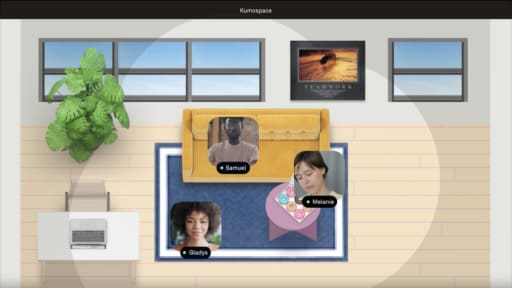
Kumospace handles a few of these problems differently because rooms and floors stay open the whole session instead of resetting between rounds. Kumospace's spatial and room audio allow multiple conversations on the same virtual floor, while participants can move between areas themselves instead of relying on a host to reassign conventional breakout rooms. That fits especially well with the hybrid escape room and clue-first detective formats above, where separate squads work in parallel and occasionally need to compare notes before the final reveal.
This isn't a replacement for your existing video platform; if your vendor-hosted mystery already runs on Zoom, that's still the right tool for that format. It's a better fit specifically for teams already using a spatial virtual office day to day, or for organizers who want the "rooms" in a hybrid escape room format to feel like actual separate spaces rather than a folder of breakout links.
Platforms for online murder mystery team building
Stable video, separate rooms people can move between, screen sharing, and chat are the baseline, and you get all of this in Zoom, Microsoft Teams, or Google Meet. For larger events, test screen sharing and breakout rooms in advance, and assign a co-host who manages room assignments while you focus on the story. Share any links to external puzzles or evidence well before the game starts so nobody spends the first five minutes troubleshooting a URL.
Enhancements that tend to work: themed virtual rooms or spatial audio spaces so different groups can gather to discuss clues, an online whiteboard or shared doc for tracking suspects and timelines, and character names used as display names. Whatever platform you use needs to hold a sustained session without dropping people. The main limitation is tech fatigue: keep the tool stack simple if your team is already juggling several platforms, or if you know some people will join by phone, since every extra tool layered on is one more thing that can break mid-game.
What makes virtual murder mystery games fail

Rules explained after breakout rooms open. People land in a room with strangers and no idea what to do. The first five minutes are confusion, and by the time someone figures it out, the energy is gone. Send a one-page quick-start summary before the event. Do a 90-second live walkthrough before anyone gets split up.
Quiet people grouped with only other quiet people. Nobody speaks. The room goes silent. Assign at least one talkative person to each squad. Rotate speaking roles or use written evidence and chat so everyone can contribute without having to unmute and perform.
The session runs past the calendar slot. Someone's next meeting starts in ten minutes, and the reveal hasn't happened yet. Boxed party kits often list two to four hours of play, but for a remote team-building slot, 60 to 90 minutes is the practical ceiling. Cut optional rounds rather than letting a session overrun.
Mandatory attendance turns it into an obligation. The moment a murder mystery game is required, the people who are overloaded start resenting it. Frame it as optional. Give explicit permission to observe instead of act. A murder mystery event where 15 willing people play is better than one where 25 reluctant people sit through it.
Pacing collapses in the middle rounds. Full-length mysteries come apart past 90 minutes, as people start checking email or muting themselves. Run a visible timer, and if every clue matters, release the clues on a schedule rather than when the slowest group finishes debating.
Virtual murder mystery for work: format, headcount, and time slot
The best virtual murder mystery format depends on your group size, available time, budget, and comfort with role-play. Downloadable kits suit small teams of 6 to 14 that enjoy improvising, while larger or first-time groups may prefer a facilitator, who can keep fifty or more people moving across parallel rooms. Clue-first games work for teams that want to solve a case without role-play, and teams whose calendars never overlap can run the case asynchronously over a week. If you've only got a standup or lunch slot, a 30- to 45-minute short mystery fits, and a hybrid group needs someone in the office making sure remote players aren't just watching.
The two failure modes to guard against are the same regardless of format: unclear rules and a session that runs long. Both are solved at the planning stage. Fix the headcount and the slot length first, 60 to 90 minutes for most remote teams, then pick the format that fits both.
Frequently asked questions
Plan for 60 to 90 minutes total, including joining, rules, gameplay, the accusation, and the debrief. That's enough for introductions, two or three clue rounds, the accusation, and a reveal that doesn't feel rushed. Short formats of 30 to 45 minutes fit a standup or a lunch slot and work better as a repeatable ritual. Save anything longer than 90 minutes for an offsite or a dedicated team day, and cut optional rounds rather than letting a session overrun.
Character-based games work best with six to fourteen people on one call. Everyone gets a part with something to do, and the accusation round stays manageable. Clue-first detective games run in squads of up to eight, and you can put several squads in parallel rooms and compare theories at the end. Above fourteen for a character game, either split into rooms with duplicate copies or book a hosted session where a facilitator can keep fifty or more people moving across parallel rooms.
No. Plenty of formats run fine with people reading their lines flat and sharing clues, and the clue-first detective style drops characters altogether. Put "costumes encouraged, not expected" in the invite. That lets the people who enjoy it lean in without putting pressure on anyone who'd rather keep their camera off and contribute in chat.
If you can find an hour inside most people's working day, take it and pick a 60-minute format so the overlap stretches further. If you can't, run it asynchronously instead. Post one piece of evidence a day for a week and let squads theorize in a channel on their own hours, with the accusation open on the last day. That's a better answer than running the same mystery twice or asking someone to join at 11 p.m.
How often you run a virtual murder mystery should depend on your team's interest and feedback; if participation or enthusiasm starts to drop, rotate in a different team-building format. Between the big ones, shorter mystery games or lighter virtual activities fill the regular team-building slot without wearing out the same format.