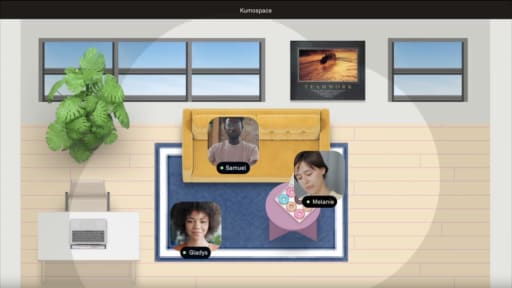
Most companies don’t choose just one type of flex space. They mix multiple options based on team structure, location needs, and growth velocity. A startup might combine a serviced private office for its core team, coworking memberships for remote employees in other cities, and a Kumospace virtual office for daily collaboration across locations.
Workspace providers offer a range of flexible office solutions, including private office suites, private office spaces, and flexible coworking spaces, designed to meet the needs of both local and remote businesses. These solutions enable organizations to adapt quickly, scale efficiently, and maintain a professional presence without the constraints of traditional office leases.
Main categories covered below:
- Serviced offices
- Shared offices
- Coworking spaces
- Hot desking and office hoteling
- Open-plan collaboration zones and focus rooms
- Virtual offices and digital flex space (Kumospace)
Serviced Offices
Serviced offices are private, fully furnished spaces with all-inclusive monthly fees covering rent, utilities, cleaning services, high-speed internet, and often reception services. You sign a short-term agreement, move in within days, and focus on work rather than logistics.
Imagine a 12-person ML team expanding to London for a new research initiative. Instead of spending six months negotiating a lease and fitting out a traditional office, they contract a serviced office and become productive within 24 hours.
Best for fast-growing AI startups, new satellite teams testing a market, and companies that need predictable costs without capital outlay.
Pros: Speed, simplicity, all-in pricing, professional meeting rooms, and amenities included.
Considerations: Slightly higher per-desk cost than raw leases and less control over branding and interior design.
Shared Offices
Shared office space means multiple companies share a floor or suite, often with part-time occupancy arrangements. A seed-stage AI startup might book three days per week in a prime Manhattan location, using that time for in-person sprint planning, pair programming, and client meetings while remote employees work from home on other days.
This model delivers lower monthly costs, access to prime locations that would otherwise be unaffordable, and organic networking opportunities with nearby teams from other businesses. Trade-offs include the need for clear guidelines around storage, IT security, and meeting room booking to avoid friction with neighbors.
Coworking Spaces
Coworking spaces are open, shared workspaces with plug-and-play desks, community events, and amenities such as conference room access, phone booths, and coffee bars. These environments foster opportunities to network and collaborate with other like-minded professionals, creating a vibrant community. Coworking spaces also offer a variety of desk space options, including dedicated desks and private offices, as well as adaptable workstations with ergonomic and customizable furniture to suit different business needs and individual preferences. They work well for freelancers, early-stage founders, and remote employees seeking a local “third place” outside the home.
By the mid-2020s, tens of thousands of coworking spaces operated globally, proving the model’s maturity and demand. For AI-first teams, coworking memberships in major tech hubs often combine with remote collaboration via Kumospace and similar tools, allowing engineers to work from professional environments anywhere while staying connected to their distributed team.
Hot Desking and Office Hoteling
Hot desking means desks are unassigned, and employees grab available seats on a first-come, first-served basis. Hot desking maximizes space utilization by allowing employees to select from available workstations, reducing unused space. Office hoteling adds a booking layer, where employees reserve desks and rooms in advance using scheduling software.
This distinction matters for hybrid work patterns. Engineers might book desks for specific days when they plan in-office sprint kickoffs, code reviews, or whiteboard sessions. A typical workflow: an engineer reserves a desk and a conference room through a booking tool, arrives for an in-person collaboration day, and joins remote colleagues in Kumospace for mixed physical-virtual meetings.
The operational benefits are significant. Fewer desks sit unused, the real estate footprint aligns with actual attendance, and scaling becomes frictionless when hiring velocity spikes.
Open-Plan Collaboration Zones and Focus Rooms
Open-plan designs work well as flexible team spaces and support modern workplace collaboration strategies. They support standups, design reviews, quick huddles, and spontaneous conversations that spark innovation. But they fail when treated as the only workspace mode.
Smart flex offices pair open spaces with quiet focus rooms or soundproof pods for deep work, client calls, and interviews. A product team might start in a lounge area brainstorming, move to a focus pod for a user interview, then return to an open zone to synthesize findings, all within the same flex space.
The key is intentional variety. Fully open layouts create noise that disrupts focused tasks. Fully closed layouts reduce collaboration and serendipity. The best flexible offices deliberately mix modes, with clear acoustic separation and signage guiding employees to the right space for each activity.
Virtual Offices and Digital Flex Space (Kumospace)
Virtual offices are persistent digital workspaces that mirror a physical floor plan, with rooms, desks, and common areas recreated online. Kumospace enables distributed teams to enter a shared office virtually, with spatial audio and room-based collaboration that simulates physical proximity. Virtual office services provide businesses with a professional business address and mail handling without the need for a physical workspace, making them an ideal solution for remote-first companies or those expanding into new markets.
This creates true digital flex space. A team might meet in person twice a month at a physical flex office while using Kumospace as their daily headquarters. Remote engineers can join the same virtual office on day one, whether they are in San Francisco, São Paulo, or Singapore, reducing onboarding friction and building team cohesion immediately.
Virtual flex space is critical for global hiring. When talent spans continents, physical proximity is impossible. Shared presence in a well-designed virtual environment creates a collaborative space and cultural connection that fully async work lacks.

The contrast is clear. Traditional office space involves fixed locations, long leases of 5-10 years, static desk layouts, and massive upfront capital expenditure for build-outs, but offers complete control over branding, space design, and operational consistency. Flex office space offers adaptable environments, short-term contracts of 1-12 months, mixed physical and virtual presence, and minimal upfront investment.
- Lease term: Traditional leases lock companies into 5-10 year commitments with substantial penalties for early exit. Flex offices operate on month-to-month or quarterly agreements, allowing businesses to adapt quickly.
- Capital expenditure: Traditional offices require security deposits, construction, furniture, and IT infrastructure. Flex spaces arrive fully equipped with high-speed internet, furniture, and amenities, requiring only laptops and employees to be productive on day one.
- Scalability: Traditional offices require relocation or subleasing to adjust capacity. Flex offices allow companies to add or reduce desks within weeks, which is critical for AI startups that may double engineering headcount after a funding round.
- Employee experience: Traditional assigned desks offer the same environment daily. Flexible workspaces provide variety with quiet areas for focus, collaborative spaces for teamwork, and social zones for informal sessions like coffee meetings. Flexible office spaces also provide a professional environment that enhances a company's image and supports effective meetings, which is crucial for client interactions. Employees choose spaces that match their tasks rather than adapting their work to static space.
- Data and tech integration: Modern flex offices include occupancy sensors, desk booking software, and analytics that inform space optimization. Traditional offices rarely have this visibility, leading to 30-50 percent of desks sitting empty without anyone realizing the waste.

Designing a successful flex office requires more than filling a space with desks and meeting rooms. Modern workplaces should be built around how teams actually work, with intentional zoning, strong technology integration, employee wellness considerations, and support for hybrid collaboration. Since the rise of remote and hybrid work, companies have shifted toward layouts that balance flexibility, productivity, and long-term scalability.
Instead of planning around headcount alone, organizations should map real workflows. Engineering and AI teams often move between different types of work throughout the day, including focused coding sessions, cross-functional planning, client meetings, and collaborative brainstorming. A strong flex layout supports these transitions with a mix of quiet focus areas, open collaboration zones, semi-private project rooms, and social spaces that encourage informal interaction.
Balancing open and private environments is especially important. Open-plan areas work well for standups, whiteboarding, and quick discussions, but teams also need quiet spaces for debugging, analysis, interviews, and deep work. Acoustic panels, soundproof booths, soft furnishings, and clear room separation help reduce distractions and improve concentration for employees working on technically demanding tasks.
Technology should also be integrated from the beginning. Reliable high-speed Wi-Fi, video conferencing tools, large displays, and desk booking systems are now core workplace infrastructure rather than optional upgrades. Many hybrid organizations also extend the office digitally through platforms, allowing remote employees to collaborate in persistent virtual spaces alongside in-office teammates.
Employee comfort and sustainability increasingly influence both productivity and hiring outcomes. Adjustable desks, ergonomic chairs, natural light, ventilation, and wellness-focused spaces improve the daily experience for employees spending long hours in technical work environments. Sustainable materials, energy-efficient lighting, and adaptable layouts also help companies reduce costs while aligning with modern workplace expectations.

Transforming from a fixed traditional office or fully remote setup to a thoughtful flex model follows a clear sequence: assess current usage, gather employee input, pilot changes, refine based on data, and scale to a comprehensive strategy. This process typically spans three to six months for meaningful results. The flexible workspace industry, along with leading workspace providers, plays a crucial role in supporting organizations through this transition by offering adaptable solutions and expert guidance tailored to evolving workplace needs
Step 1: Audit How Your Current Space Is Really Used
Before redesigning your office, analyze how employees actually use the space. Track patterns over several weeks using meeting room data, occupancy tools, or employee surveys to identify crowded areas, underused zones, and common workflow needs.
Step 2: Co-Design with Your Team
Include engineers, product managers, designers, and recruiters in the planning process. Collaborative workshops help teams define ideal layouts, booking rules, quiet hours, and collaboration spaces that reflect real workflows and day-to-day needs.
Step 3: Pilot a Flex Layout and Iterate
Start with a small pilot before rolling changes out company-wide. Test hot desking, focus rooms, and desk booking systems for 60-90 days while tracking utilization, employee morale and satisfaction, scheduling efficiency, and onboarding feedback. Use the results to refine the layout and policies.
|
Metric |
What It Measures |
|
Utilization rate |
Percentage of desks and rooms actually used |
|
Employee satisfaction |
Survey scores on workspace quality |
|
Time-to-schedule |
How long does it take to book the needed meeting spaces |
|
New hire feedback |
Onboarding experience ratings from recent hires |
Step 4: Scale Flex Principles and Embed in Culture
Once the pilot succeeds, expand the model across offices and hybrid teams. Train managers to support flexible work styles, combine in-person and remote collaboration practices, and regularly revisit layouts as team needs evolve. Flex office design works best as an ongoing process rather than a one-time project.